Becoming Invisible at 50? 7 Reasons It's Not You — It's Society (And What to Do)
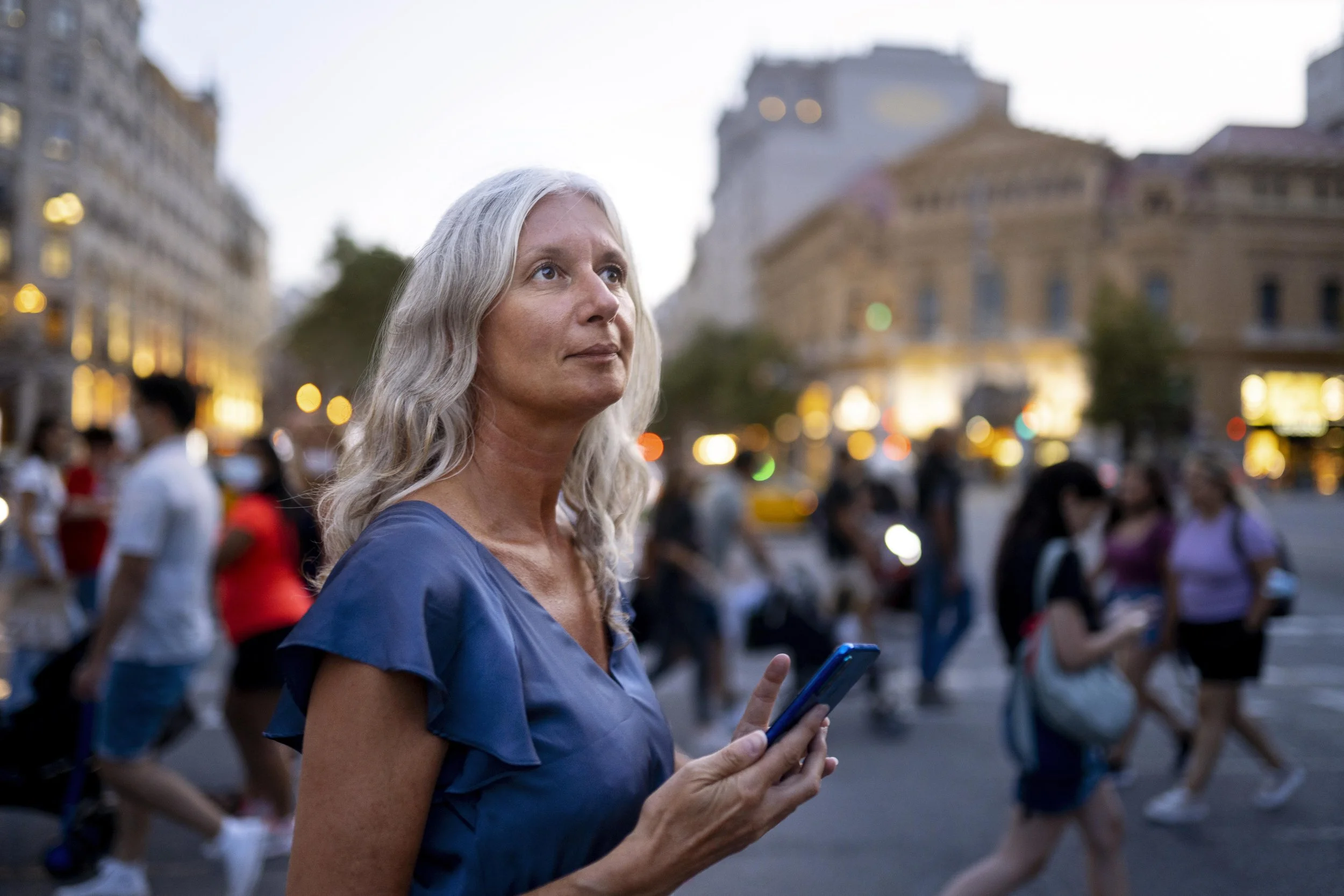
It happens in small ways at first. The waiter looks past you to ask the younger woman at your table what she'd like. The shop assistant continues helping a customer who arrived after you. A man in a meeting talks over you, and afterwards no one mentions it. You walk down a street you've walked for twenty years and notice — actually notice — that no one looks up. Not in a way that matters. You're simply, somehow, not registering anymore.
Most women in their early 50s describe some version of this. Many describe it with confusion, because the experience is so subtle and so cumulative that it's hard to point to. There's no single dramatic moment. Just a slow dawning that the world's attention, which used to land on you constantly — sometimes welcomely, sometimes not — has quietly redirected itself elsewhere.
And then comes the second-order disorientation: the suspicion that you're imagining it. That you're being self-pitying, or paranoid, or insufficiently confident. The cultural script is to dismiss the experience or convert it into a personal problem to be solved with better posture, brighter clothing, more energy, or a renewed gym membership.
This piece is here to do something different. Before we talk about what to do, we're going to name what's actually happening — because what's happening isn't, primarily, you. It's a culture with a very specific relationship to women in midlife, and that relationship has consequences you've been quietly absorbing your whole adult life. The consequences just become unmissable around now.

You are not imagining it. The relief of knowing that is the first piece of solid ground.
Seven reasons it's not actually you
The seven below are not a complete list — but they're the most structural. Most of what women experience as personal invisibility around 50 is the cumulative weight of these forces, encountered one after another, often within the same week.
1. Female value has been culturally tied to youth — and that's recent, not eternal
It's worth saying clearly: the equation between female worth and youth is not a fixed feature of human history. In many cultures, across many centuries, older women were holders of authority, wisdom, ceremony, and considerable social weight. The contemporary Western tendency to discard women aesthetically and socially in their fifties is a relatively young phenomenon — largely a twentieth-century construction, accelerated by mass media and the beauty economy.
This matters because the feeling of invisibility carries an implicit weight: this is just how it is. It isn't. It's a particular cultural moment with a particular history. Knowing that doesn't dissolve the experience, but it changes its size in your mind. You're not aging out of some natural order. You're encountering a recent cultural arrangement that happens to be confused about you.
2. Visibility, in our culture, has been mostly about sexualisation
This is the uncomfortable structural fact underneath the experience. The kind of attention women receive in public from their teens through their forties is largely sexual or sexualising — even the parts that look professional or social. We don't talk about it that way, but it's what's underneath much of the eye contact, the room-changing presence, the way conversation reorganises around an attractive young woman.
When that attention stops — and around 48 to 52 it does, fairly suddenly for most women — what disappears isn't your worth. What disappears is the specific currency of being looked at as a sexual object. We've been conditioned to experience that as the only kind of being-seen on offer, so the absence registers as total invisibility. But it's not. It's the loss of one type of regard, and that type of regard was always more cage than crown.

The currency you've lost was always rented. The loss is real, but it's a release as much as a robbery.
3. Mainstream media still under-represents women over 50, especially as autonomous beings
Open most magazines, most films, most television. Count the women over 50 in central, autonomous roles — not as someone's mother, someone's wife, the kindly side character, the comic relief, or the cautionary villain. The number is still vanishingly small.
This shapes how the culture sees you, and — more insidiously — how you see yourself. You've been swimming in images of who counts as visible your entire life, and at 50, you reach an age range that's largely missing from the picture. The brain registers that absence, even unconsciously. It interprets it as: people like me don't show up here. Which means people like me must matter less.
They don't. The under-representation is a failure of the industries, not of the women they're failing to depict.
4. Workplace ageism hits women earlier and harder than men
This one is documented and stubborn. Studies across multiple decades show that women experience age-related career penalties roughly a decade earlier than men do. A man at 55 is often described as experienced, gravitas, in his prime. A woman at 55 is often described as someone who should perhaps be thinking about transitioning out.
If you've felt this in your own career — colleagues stopping by your desk less, fewer invitations to high-visibility projects, a younger colleague's idea heard with more enthusiasm than yours — you're not being paranoid. You're encountering something real. And like all structural patterns, it's exhausting precisely because it's diffuse: rarely does it manifest as a single discriminatory event you can name. It's the cumulative texture of being slightly under-considered, day after day.
5. The beauty and wellness industries profit from your fear of invisibility
This deserves naming directly. There is a multi-billion-dollar economy built on selling women in midlife the promise that they can avoid becoming invisible — through serums, treatments, procedures, supplements, and lifestyle programmes designed to extend the years during which the male and cultural gaze still attends to them.
The industry needs you to feel the dread. Without the dread, the products don't sell. So the messages — "look 10 years younger," "fight the signs of aging," "defy your age" — are everywhere, all the time, calibrated to keep you mildly anxious about exactly the thing this article is about. Some of what feels like a personal experience of becoming invisible is actually the manufactured ambient hum of an industry actively cultivating that feeling in you so you'll buy the antidote.
None of this means you can't enjoy skincare or wellness practices. It means the underlying narrative — that without these interventions you become nothing — is a sales pitch, not a truth.
6. The implicit insult inside "You look great for your age"
"You look great for your age." "You don't look 55." "You'd never know." These are meant as compliments, but listen to what they actually contain: your real age is something to be hidden, escaped, or graded against. The compliment is a relief on a default of disappointment. It treats your authentic self as the thing that's been disguised.
Many women in midlife absorb hundreds of these comments and never name what's wrong with them. The cumulative effect is a quiet internalisation of the message: my real age is the problem; my visible appearance is what's keeping me acceptable. That's a heavy load to carry, and it's one of the deeper sources of the invisibility experience — because it teaches you to measure yourself constantly against an imaginary, eternally-younger version of yourself, and to feel ashamed of any gap.
7. Society conflates "older woman" with "less relevant" — even where it has no business doing so
The invisibility extends beyond the social and aesthetic. It shows up in medical settings, where women in midlife are routinely under-listened to and over-medicated. In financial services, where they're patronised. In professional contexts, where they're talked over. In family dynamics, where their preferences are deprioritised.
The cultural assumption — rarely stated, constantly operative — is that an older woman is inherently less worth attending to. Her health concerns are dismissed as anxiety. Her financial questions are answered to her husband. Her professional opinions are heard, then quietly bypassed. Each individual instance is small and deniable. The pattern is what wears you down.

Most of what feels like personal invisibility is, on closer look, structural inattention. Naming it shifts something — even when it doesn't yet change anything externally.
So what do you actually do?
Now, with the analysis on the table, we can talk about action — but with a different kind of intelligence than the usual advice. Most of what's offered to women in this position is essentially a remediation programme: be brighter, louder, sharper, more present, more polished. Reclaim the gaze you've lost. The premise of all of it is that visibility (as the culture has defined it) is the goal, and you should work harder to perform it.
The four moves below come from a different premise. They're not about getting the old visibility back. They're about renegotiating your entire relationship to being seen.
Stop performing visibility for the gaze that's left you
Many women in midlife continue, often unconsciously, to perform for the same audience that stopped looking — the men, the rooms, the industries, the cultural eyes that built their early sense of worth. The performance becomes increasingly costly because the audience is no longer there, and the absence reads as failure.
Stop performing for them. Genuinely. Not as a defiant gesture but as a quiet recalibration. Notice where you're still dressing, presenting, speaking, or shaping yourself for the gaze that's left you, and consciously redirect that energy toward the people, contexts, and ways of being that actually nourish you. This sounds simple. It's actually one of the hardest internal pivots a woman makes in midlife. It requires giving up not just the audience but the version of yourself that organised around it.
Find or build the spaces where you are, in fact, seen
The cultural mainstream may not see you. That doesn't mean no one does. There are communities, friendships, professional contexts, creative spaces, and gatherings where women in midlife are not only visible but central — where their experience, voice, and presence are exactly what's wanted.
Find them. If they don't exist near you, build them. This isn't a substitute for being seen by the wider world. It's a recognition that the wider world is an abstraction, while the specific people in your actual life are real. The friendship that lights up when you walk in. The colleague who consults you because she values your judgment. The community of other women working through similar territory. These contexts matter more, day to day, than any number of strangers on a street.
Many women find that rebuilding female friendships in midlife becomes the single most important antidote to the invisibility experience. Not because friendship cures the structural problem, but because it provides a different, more durable form of being seen.
Reclaim attention as something you give, not something you seek
This is the deepest of the moves. Most of us have spent our lives oriented toward receiving attention — managing how it landed on us, working to attract more of it, suffering when it withdrew. By midlife, the question worth asking is: what would it mean to flip the polarity? To experience attention primarily as something you bestow rather than something you require?
Women who do this well describe a quiet, unexpected liberation. The world becomes less a stage you're performing on and more a landscape you're walking through. The eyes that don't look at you matter less because the eyes that matter most are now your own — turned outward, with curiosity, toward what's in front of you. This is a real, internal repositioning, not a slogan. It takes practice. But it's perhaps the single most freeing shift available to a woman in this stretch of life.
Notice where invisibility is, quietly, also a freedom
This is the move that balances the others — and the one no one writes about, because it sounds disloyal to the experience of loss. But it's true, and it matters.
The invisibility you're experiencing comes with a peculiar set of liberations. Walking down a street and not being looked at is also walking down a street and not being assessed. Going to a restaurant and not turning heads is also eating in peace. Aging out of a particular kind of constant evaluation — about your body, your face, your desirability — is also aging into a kind of privacy you have not known since you were eleven.
Many women, asked honestly, will admit there's a deep-running relief inside the invisibility. Less time spent on appearance. Less pressure to be charming on demand. Less of the low-grade vigilance that women in their twenties and thirties live inside without naming. The invisibility, if you're willing to look at it directly, is also a homecoming.
Holding both at once — the loss and the freedom — is the most accurate response to this whole experience. It's not naive optimism. It's not bitter resignation. It's the kind of clear-eyed, both-handed understanding that midlife actually trains in women who pay attention.

Make it stand outThe invisibility is real. The freedom inside it is also real. You're allowed to feel both.
A note on what changes once you see it clearly
Naming the structural nature of this experience — the seven cultural patterns above, plus the four internal moves — does something specific. It doesn't make the patterns go away. It does, however, change your relationship to them. The invisibility you experience tomorrow at the coffee shop will land differently than it did yesterday, because you'll know where it's actually coming from. It won't be your fault. It won't be a personal failure. It will be a particular cultural arrangement you happen to be navigating, and which you no longer have to absorb as evidence of your own diminishing worth.
From there, the work is mostly internal. You become the woman who knows what's happening, who isn't fooled by the mythology of it, and who is increasingly building a life that doesn't depend on the eyes of strangers to confirm her existence. That's a different woman than the one who arrived in midlife confused and self-doubting. And that woman is, in many ways, the one this whole stage of life is asking you to become.
If the experience of invisibility has tied you in knots — replaying conversations, second-guessing yourself, wondering if it's all in your head — you may also recognise the texture of this in a deeper pattern of organising yourself around what others think. Putting that pattern down is part of the same work as learning to live with reduced cultural attention. They're connected.
You're not disappearing. The world's regard is just being redistributed, and your job — quietly, over the next few years — is to redirect your own attention toward the things, people, and parts of yourself that were always there, waiting to be looked at properly. That includes you.
If this resonated, our weekly letter is written for women navigating exactly this kind of cultural reckoning. Subscribe at femmementor.com.